
By Mika Leah, CEO and Founder of Goomi Group

TL;DR: New research reveals that exercise releases “exerkines” — molecules that directly boost memory and focus. Learn how leveraging corporate wellness programs to trigger this biological response can eliminate brain fog, improve employee productivity, and protect your team’s long-term cognitive health.
Is Your Workforce Running on “Low Power Mode”? -The Missing Link in Productivity Strategy
In the modern business landscape, we obsess over optimization. We invest heavily in productivity software, streamline our workflows with AI, and redesign our offices for maximum efficiency. Yet, despite these investments, many organizations are still plagued by a silent epidemic: the afternoon slump, “brain fog,” and a gradual decline in creative innovation.
We are spending billions upgrading our software, but we are neglecting the hardware: the human brain.
For years, corporate wellness programs were viewed primarily as a tool for physical health—a way to lower insurance premiums or reduce sick days. While those benefits are real, they miss the most immediate and valuable return on investment. A new wave of neuroscience research, recently highlighted in the New York Times, confirms that the single most effective way to sharpen executive function and memory is not a new app or a double espresso — it is physical movement.
If your workforce is sedentary, they are operating in “low power mode.” To unlock their full potential, we need to shift our focus from simple fitness to brain health at work.
The Science of “Exerkines”: A Biological Software Update
To understand why a workout is a productivity tool, we have to look at the biology of the brain. When we engage in physical activity, our muscles, fat cells, and organs release special signaling molecules into the bloodstream called exerkines.
Think of exerkines benefits as a software update for your neurons. These molecules travel from the muscles to the brain, where they go to work immediately. According to neurologists, they facilitate the growth of new connections between neurons and help repair existing brain cells. This process is critical for maintaining “plasticity”, or the brain’s ability to adapt, learn new skills, and solve complex problems.
When an employee engages in a virtual fitness class or takes a brisk walk, they aren’t just burning calories. They are flooding their brain with oxygen, glucose, and these powerful exerkines. The result is a measurable improvement in cognitive function in the workplace. Employees return to their desks with sharper focus, faster processing speeds, and a greater ability to filter out distractions.
The Cost of the Chair: Sedentary Lifestyle Risks
Conversely, the modern office environment is often designed to work against our brain health. A sedentary lifestyle does more than just increase the risk of cardiovascular disease; it actively accelerates cognitive decline.
Research on the hippocampus (the region of the brain responsible for learning and memory) shows that it naturally shrinks by about 1% to 2% per year in older adults. This shrinkage is often a precursor to memory loss and conditions like Alzheimer’s. However, this decline is not inevitable. Hippocampus health is directly linked to physical activity. Studies suggest that consistent exercise can not only halt this shrinkage but potentially reverse it, increasing the volume of the hippocampus and “age-proofing” the brain.
For a business leader, the implication is stark. A workforce that sits for 8 hours a day is biologically prone to slower learning and reduced memory retention. By failing to address sedentary lifestyle risks, companies are inadvertently allowing their most valuable asset—their collective intelligence—to atrophy.
Strategic Intervention: The Lunchtime Reset
So, how do we operationalize this science? You cannot simply tell employees to “exercise more.” You must provide the structure and culture that makes movement accessible. This is where lunchtime workout benefits become a strategic asset.
The mid-day block is the battleground for productivity. Typically, energy levels crash around 2:00 PM. Instead of powering through with caffeine (which offers a temporary jittery boost), a 20-to-30-minute workout provides a sustainable reset.
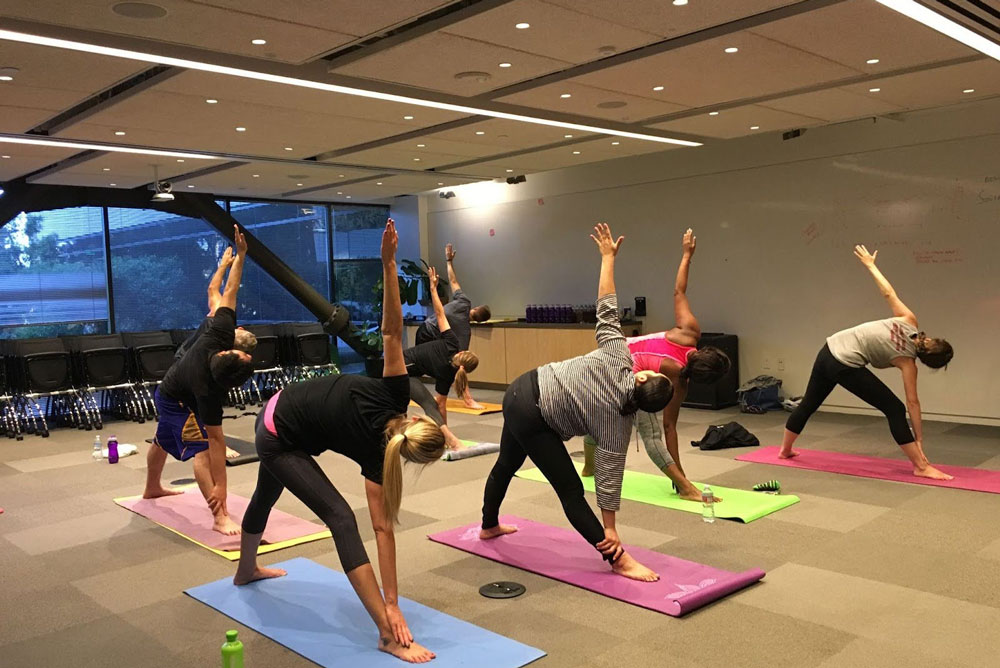
By offering virtual fitness classes during the lunch hour (such as High-Intensity Interval Training (HIIT), Yoga, or Pilates) you provide a mechanism for employees to release those exerkines right when they need them most. This isn’t just a break from work; it is a preparation for the second half of the day. Employees who exercise at lunch report higher levels of mental clarity at work and better mood regulation in the afternoon.
The “Temptation Bundling” Secret
Knowing the science is one thing; changing behavior is another. How do you get busy professionals to step away from their inboxes?
Behavioral scientists suggest a strategy called “temptation bundling,” which is pairing a habit you should do (exercise) with something you want to do. In the context of the NYT brain challenge, this might mean listening to a favorite audiobook while walking. In a corporate context, Goomi Group leverages this by bundling fitness with connection.
We find that team building fitness challenges are the ultimate bundle. Employees might feel too busy to work out alone, but they will show up to see their colleagues. When a workout is a social event; a chance to laugh, sweat, and connect with remote peers, it becomes a “want to do” activity.
This social component does double duty. It drives high engagement rates (solving the “ghost town” problem of unused wellness apps) and combats isolation. The result is a preventing workplace burnout strategy that tackles both physical and emotional exhaustion simultaneously.
Executive Functioning and the Bottom Line
Ultimately, investing in executive functioning exercises—which is exactly what complex movement is—delivers a tangible ROI.
Consider the daily tasks of your leadership team: strategic planning, conflict resolution, complex data analysis. These are all “executive functions” of the brain. When you implement a program that enhances these functions, you are directly improving the output of your company.
The workplace wellness ROI is no longer just about insurance savings (though those are significant). It is about the opportunity cost of lost innovation. A sharp, resilient mind is an agile mind. By making movement a core pillar of your company culture, you are building a workforce that learns faster, stresses less, and stays sharper for the long haul.
Conclusion: Move to Think
The science is clear: the brain was built to move. In the search for higher employee productivity, we must stop treating the mind and body as separate entities. They are a single, integrated system.
At Goomi Group, we design our programs not just to make your employees sweat, but to help them think. Whether it’s a brain-boosting cardio session or a stress-reducing yoga flow, every class is an investment in your company’s cognitive capital.
Don’t let your team run on empty. Give them the “exerkine” advantage.
Frequently Asked Questions
- How does physical exercise improve employee productivity?
Physical exercise triggers the release of molecules called “exerkines” and increases blood flow to the brain. This biological process enhances executive function, memory, and focus, directly leading to better decision-making and higher productivity during the workday.
- What is the best time of day for a corporate workout to boost brain health?
While any time is beneficial, a midday or “lunchtime” workout is highly effective for corporate teams. It combats the afternoon energy slump by oxygenating the brain and resetting focus for the second half of the workday.
- Can virtual fitness classes really help with team building?
Yes. By using “temptation bundling” (combining exercise with social interaction) virtual group classes create a shared experience. This fosters accountability and community, helping remote and hybrid teams feel connected while improving their physical health.
- What are “exerkines” and why do they matter for corporate wellness?
Exerkines are signaling molecules released by muscles during exercise that travel to the brain to support neuron growth and repair. Understanding this biological link helps companies realize that corporate wellness programs are not just for physical fitness, but are essential tools for maintaining mental sharpness and innovation.
About the Author: Mika Leah is the Founder and CEO of Goomi Group, where she combines her passion for wellness with a talent for making healthy living accessible and fun. When she’s not helping companies transform their wellness programs, you might find her practicing what she preaches – usually with a green smoothie in one hand and a spreadsheet of ROI calculations in the other.